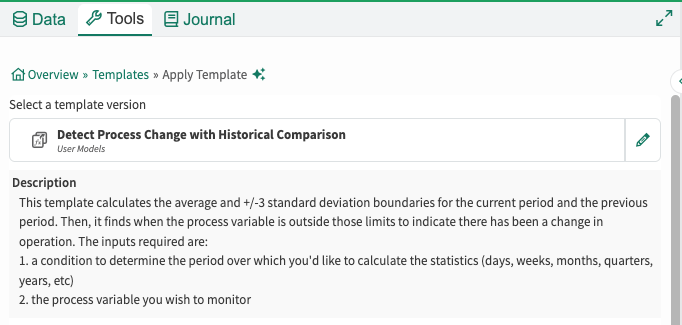
Industry templates are now included on every Seeq server. These templates were created by Seeq Analytics Engineers as a starting point for common use cases and this library will continue to expand to include more standardized starting calculations.
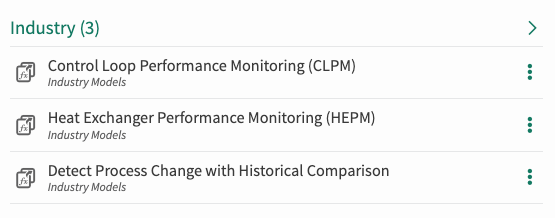
Access and Permissions
Industry Templates are shared with the Everyone group with read-only access. To access Industry Templates the Everyone group must be enabled. If your organization disables Everyone or excludes users from that group, those users will not be able to use Seeq’s Industry Templates. Contact your Seeq administrator to configure access for the appropriate users or groups.
Read access to Industry Templates allows users to apply the templates. No users are allowed to edit or modify a Seeq Industry Template. To customize an Industry Template to suit the needs for your use case, duplicate it and edit the copy.
Administrators and users with the Analytics Administration capability have read access independently of Everyone membership.
Control Loop Performance Monitoring (CLPM)
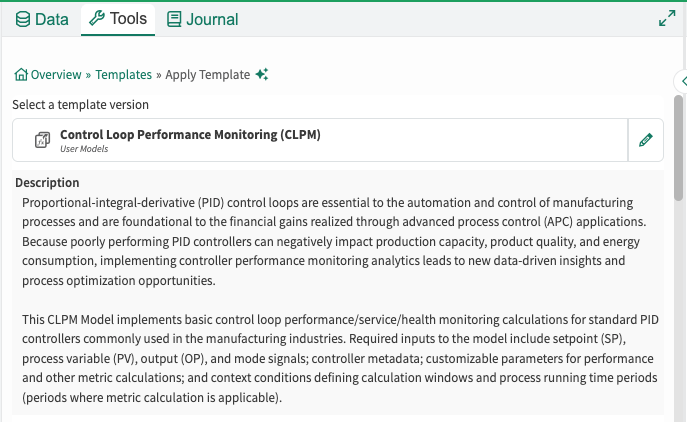
Proportional-integral-derivative (PID) control loops are essential to the automation and control of manufacturing processes and are foundational to the financial gains realized through advanced process control (APC) applications. Because poorly performing PID controllers can negatively impact production capacity, product quality, and energy consumption, implementing controller performance monitoring analytics leads to new data-driven insights and process optimization opportunities.
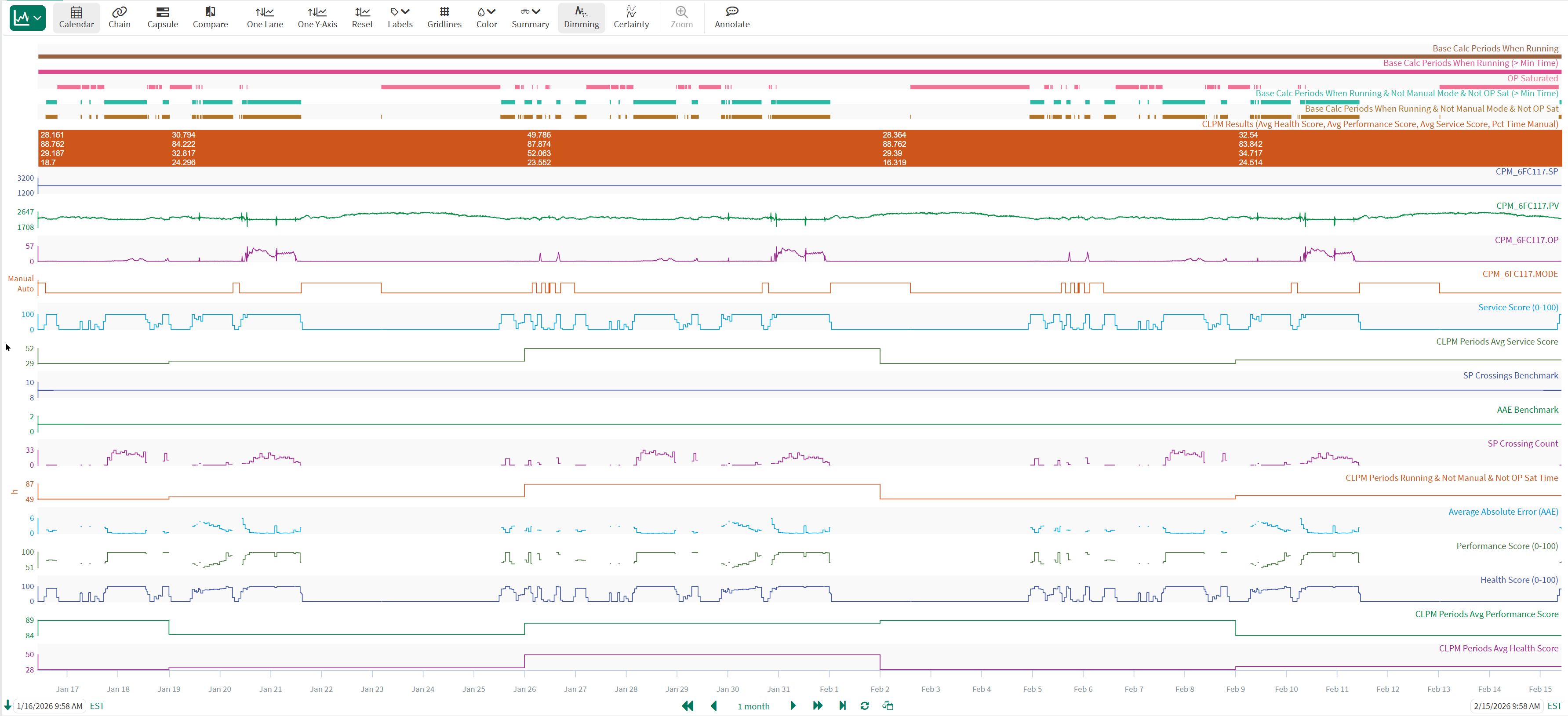
This CLPM template implements basic control loop performance/service/health monitoring calculations for standard PID controllers commonly used in the manufacturing industries. Required inputs include setpoint (SP), process variable (PV), output (OP), and mode signals; controller metadata; customizable parameters for performance and other metric calculations; and context conditions defining calculation windows and process running time periods (periods where metric calculation is applicable). Outputs include controller service/performance/health scores and other monitoring metrics, both as signals and stored as properties of a periodic condition.
This CLPM template is intended as a starting point for scaled controller performance monitoring using basic metrics, and is designed with Seeq Vantage enabled continuous improvement workflows in mind.
Example Outputs
Heat Exchanger Performance Monitoring
Heat exchangers are critical assets in manufacturing and other energy-intensive industrial processes, directly impacting production efficiency, energy consumption, equipment reliability, and overall operational costs. Fouling, scaling, flow imbalances, and process upsets can degrade heat exchanger performance over time, leading to reduced thermal efficiency, increased utility usage, unplanned downtime, and lost production opportunities. Implementing heat exchanger performance monitoring analytics enables data-driven insights into exchanger health, operational efficiency, and maintenance optimization opportunities.
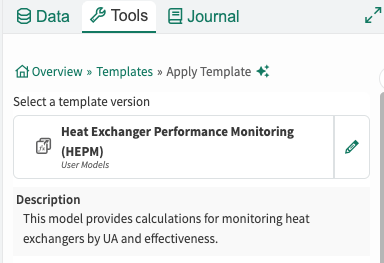
This Heat Exchanger Performance Monitoring template implements calculations focused on thermal effectiveness and overall heat transfer coefficient (UA) monitoring for common heat exchanger configurations used throughout manufacturing industries. Required inputs include process temperatures, flow rates, fluid properties, and context for defining the last cleaned window. Outputs include calculated exchanger effectiveness, estimated UA values, and alerting conditions when values drop below critical thresholds.
This HEPM template is intended as a starting point for scaled heat exchanger performance monitoring using effectiveness- and UA-based analytics and is designed with Seeq Vantage-enabled continuous improvement workflows in mind.
Detect Process Change with Historical Comparison
Many methods are used to detect whether a process variable is behaving abnormally. A common use case in Seeq is to compare the current samples to the norm of the previous day, week, month, etc. This template simplifies finding these anomalies by calculating the current period’s average and standard deviation boundaries as well as the previous period’s statistics. It then compares the current process variable to these historical boundaries. The resulting conditions can be leveraged with notifications or Vantage workflows to detect abnormal operations. This template is simple in that it only requires a process variable and a periodic condition over which the calculations should be done.